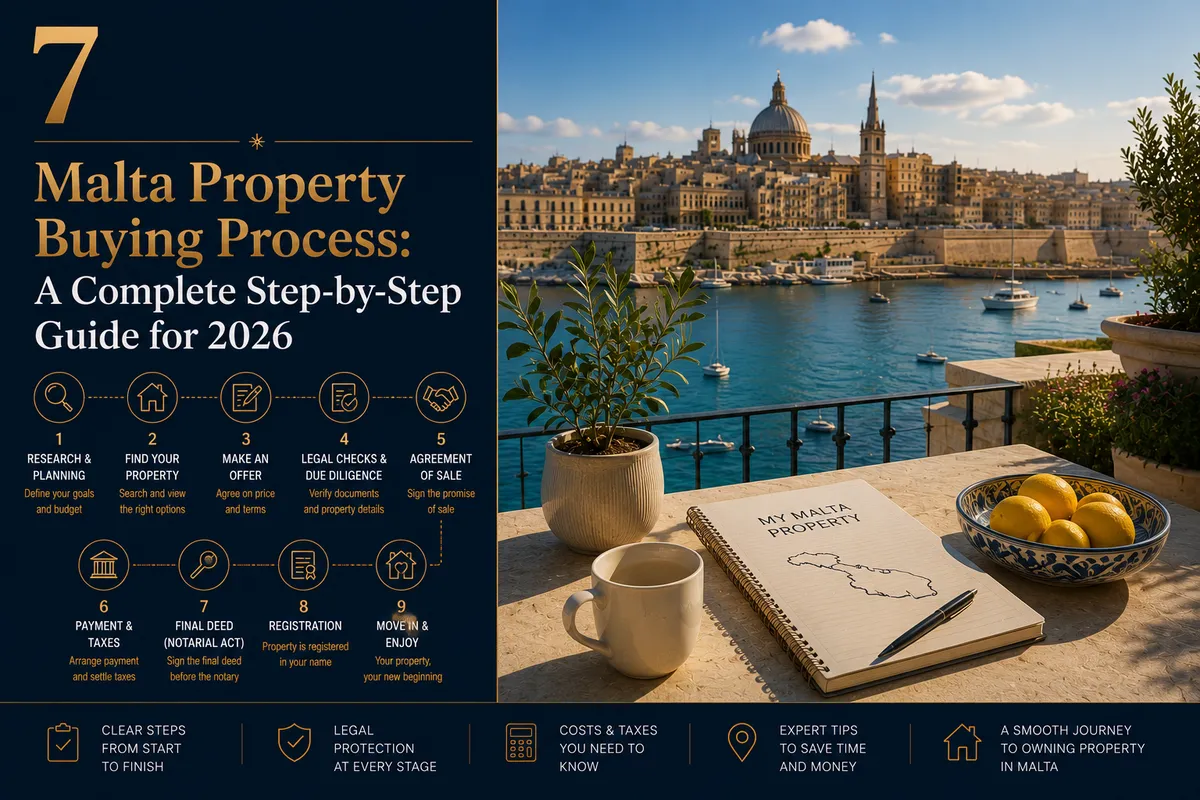
Malta Property Buying Process: A Complete Step-by-Step Guide for 2026
7 Malta Property Buying Process: A Complete Step-by-Step Guide for 2026
Most people buying property in Malta for the first time arrive with the same assumption: it will work like buying a home back in Germany, Italy, the UK, or wherever they came from.
It does not. Malta has its own legal framework, its own terminology, its own professional roles, and its own two-stage contract system. None of this is complicated once you understand it — but going in without that understanding is where buyers lose deposits, miss deadlines, and find themselves in situations they could have avoided entirely.
This guide walks you through the complete Malta property buying process in the order it actually happens — from the moment you start your search to the day you receive the keys. Every stage, every cost, every document, and every decision point, explained plainly.
FROM OUR TEAM Alliance by Let Buy Mark has completed over 1,000 transactions across Malta and Gozo. We are expats who went through this process ourselves before we ever guided a client through it. What follows is the guide we wish someone had handed us on day one.
The Process at a Glance: From Search to Keys
The Malta property buying process has two formal legal stages — the Konvenju (Promise of Sale) and the Final Deed of Sale — with a due diligence period in between. Here is the full timeline.
PHASE 1 Weeks 1–4
Property search, viewings, offer negotiation, notary appointment
PHASE 2 Week 4–5
Konvenju signed. 10% deposit paid. 1% stamp duty paid. Legal searches begin.
PHASE 3 Weeks 5–18
Notary due diligence: title search, permit checks, AIP application (if needed), mortgage finalisation
PHASE 4 Week 16–20+
Final Deed signed. Remaining balance paid. 4% stamp duty paid. Notary fees settled. Keys received.
AFTER DEED Within 15 days
Notary registers deed at Public Registry and Land Registry
TIMELINE REALITY A straightforward purchase — finished property, clean title, EU buyer as primary residence — typically completes in three to four months from Konvenju to Final Deed. Add four to six weeks if an AIP permit is required. Add further time for mortgage finance from a non-Maltese lender, older properties with complex title histories, or unrenovated buildings requiring planning verification.
The Full Process: Step by Step
STEP 1 Define your brief — before you view a single property
The single most time-saving thing you can do before starting your search. Decide: are you buying as a primary residence or as an investment? Finished property or renovation project? Inside a Special Designated Area (for maximum ownership flexibility) or open market? Long hold or medium-term? Budget including acquisition costs, not just purchase price. These decisions determine which areas, which buildings, and which agents are relevant to you — and eliminate weeks of looking at properties that were never right for your situation.
STEP 2 Choose your agent and start your search
A good Malta agent does not just send you listings. They filter by your actual criteria, flag buildings with known issues (poor management committees, high service charges, structural concerns), introduce you to off-market opportunities, and tell you when a listed price is 15% above what it will actually sell for. We strongly recommend viewing properties in person before committing. A two-day visit to Malta will tell you things about orientation, noise, neighbourhood feel, and natural light that photographs cannot. Visit properties at different times of day — morning and early evening — to get an accurate sense of the area.
STEP 3 Make an offer and agree terms
Once you identify the right property, your agent negotiates on your behalf. In Malta, asking prices routinely carry a 10%–18% margin. Come to negotiations with comparable transaction data — which any good agent should provide as standard. Agree not only on price but on what is included (fitted kitchen, air conditioning units, furniture if relevant), the proposed Konvenju period, any conditional clauses (subject to bank loan, subject to AIP permit, subject to specific planning checks), and the agreed completion date.
STEP 4 Appoint your notary
In Malta, the buyer appoints and pays the notary. This is a critical appointment — your notary acts exclusively in your interest throughout the entire process. They draft and authenticate the Konvenju, conduct all title and permit searches, manage the AIP permit application if required, prepare the Final Deed, pay stamp duty on your behalf to the Commissioner for Revenue, and register the deed at the Public Registry. Choose a notary with specific residential property experience. Ask your agent for a recommendation based on your transaction type — the right notary for a Valletta palazzo restoration is not necessarily the right notary for a straightforward SDA apartment purchase.
STEP 5 Sign the Konvenju (Promise of Sale)
The Konvenju — from the Latin 'convenire', to come together — is a legally binding preliminary agreement between buyer and seller. It is drawn up by your notary and signed by both parties in the notary's presence. The Konvenju sets out the agreed purchase price, the property description, the Konvenju period (typically three months, extendable to six by mutual agreement), all conditional clauses, and the scheduled date for the Final Deed. At signing, two payments are made: a 10% deposit (held by the notary as stakeholder until the Final Deed) and 1% of the total purchase price as provisional stamp duty, registered with the Commissioner for Revenue within 21 days of signing. If the Konvenju is not registered within 21 days, it expires automatically. Your notary handles this registration as a matter of course.
STEP 6 AIP permit application — if required
If you are a non-EU buyer, or an EU buyer under five years Malta residency purchasing a second property, your notary submits an AIP (Acquisition of Immovable Property) permit application during the Konvenju period. Required documents: two passport photographs, a copy of your signed Konvenju, a copy of your passport, and a declaration of intended residential use. The permit fee of €233 is paid on approval. Processing takes approximately 35 days. The Konvenju timeline is deliberately set to accommodate this. If you are purchasing inside a Special Designated Area, no AIP permit is required regardless of your nationality.
STEP 7 This is where your notary earns their fee
During the Konvenju period they conduct a full title search at the Public Registry to confirm the seller has unencumbered, transferable title; a Land Registry search using a Form E with an official site plan; verification that all building permits and planning permissions are in order and that the physical property matches the permitted plans; a check for any outstanding hypothecs, mortgages, court orders, or liens on the property; and, for older properties, identification of any ground rent (cens) or enfiteusi arrangements that may affect future ownership or resale. For properties in Valletta, Rabat, Mdina, or the Three Cities, your notary should also verify Heritage Malta scheduling status, which can limit future alterations.
STEP 8 Mortgage application — if applicable
If you are financing the purchase, your mortgage application should run in parallel with the Konvenju period — not after it. Malta's mortgage market is dominated by Bank of Valletta and HSBC Malta. EU buyers purchasing as primary residents typically receive the most favourable terms: deposits of 10%–20% and rates currently in the 2.5%–4% range for well-qualified applicants. Non-resident or foreign buyers face deposit requirements of 25%–35% and rates of 3.5%–5.5%. The bank's sanction letter is required before the Final Deed can be signed. If finance is a condition of the Konvenju (which it should be, if a mortgage is involved), the Konvenju period must allow sufficient time for the sanction letter to be issued. Before the Final Deed at a bank, you will also need life insurance and building insurance policies in place as assigned to the bank.
STEP 9 Utilities and pre-deed preparation
In the week before the Final Deed, several practical matters should be resolved. The seller should confirm that all outstanding utility bills — electricity, water, ground rent where applicable, building maintenance fees — have been paid in full. Receipt of payment is presented at the Final Deed signing. Transfer of utility accounts (ARMS Limited for electricity and water) requires a specific form with meter readings, signed by both parties, ideally the day before the deed. If you intend to take possession immediately after signing, also arrange building insurance cover to begin from the deed date.
STEP 10 Sign the Final Deed of Sale
The Final Deed is the legal transfer of property ownership. It is signed at your notary's office — or at the bank's office if a mortgage is involved, in which case the bank's representative will also be present. The contract is read aloud in full by the notary. Both parties sign if in agreement. If either party cannot be physically present, a properly drafted and apostilled Power of Attorney is required. At signing, the following payments are made: the remaining balance of the purchase price to the seller, the remaining 4% stamp duty to the Commissioner for Revenue, and the balance of the notary's fees. If a mortgage is involved, the bank transfers funds directly and the loan deed is signed simultaneously. Keys are handed over at this point. You own the property.
STEP 11Post-deed registration — handled by your notary
Within 15 days of the Final Deed signing, your notary is legally required to register the transfer at the Malta Public Registry (and the Land Registry where applicable), pay all outstanding stamp duty to the Commissioner for Revenue, and provide authenticated copies of the deed to all parties. You will receive official documentation confirming your registered ownership. If you purchased outside an SDA as a non-EU buyer, a copy of the notarial deed must also be provided to the AIP section of the Capital Transfer Duty Department.
Want to walk through this process with a team that has completed it over 1,000 times? Book a free consultation with Alliance by Let Buy Mark — letbuymark.com
The Full Cost of Buying Property in Malta
The rule of thumb is simple: budget 8%–10% on top of the purchase price for all acquisition costs. On a €450,000 apartment in Sliema, that is approximately €36,000–€45,000 above the property price. Here is the full breakdown.
IMPORTANT: THE DEPOSIT IS NOT AUTOMATICALLY REFUNDABLE The 10% deposit paid at the Konvenju is held in escrow by the notary. If the buyer withdraws from the purchase without a valid contractual reason (such as a failed mortgage clause or AIP refusal, if these are written into the Konvenju), the seller is legally entitled to retain the full deposit. If the seller withdraws, they must return double the deposit to the buyer. This is why conditional clauses in the Konvenju — particularly the mortgage clause and the AIP clause — are not optional extras. They are your financial protection. Always have these inserted if they apply to your situation.
[INTERNAL LINK: Malta property stamp duty, notary fees, and all purchase costs explained]
[INTERNAL LINK: Property conveyancing Malta: the complete legal process explained]
Where the Process Goes Wrong: The Five Most Common Problems
1. Conditional clauses not written into the Konvenju
If you need a mortgage and it is not written as a condition of the Konvenju, you have no contractual protection if the bank declines. If you need an AIP permit and it is not a condition, you are still legally committed to complete even if the permit is refused or delayed. Always insist that all relevant conditions — finance, AIP, planning checks on older properties — are included as formal clauses before you sign anything.
2. Choosing a notary based on cost rather than experience
The difference in notary fees between the cheapest and a specialist is often €2,000–€4,000 on a €400,000 purchase. A missed hypothec, an unregistered alteration, a ground rent obligation discovered after the Final Deed — any one of these costs multiples more to resolve than it would have cost to use an experienced notary in the first place. For foreign buyers especially, notary quality is the single most important professional decision in the entire process.
3. Not ordering an independent structural survey
Malta has a large volume of building stock from the 1960s through 1980s that looks presentable on the surface and conceals serious damp, structural, or membrane issues beneath. An architect's structural survey costs €200–€500. What it can find — and save you from — is worth orders of magnitude more. Never skip it on any property built before 1990, and never rely on the seller's own architect for this.
4. Rushing the Konvenju period
Some buyers, particularly those buying from overseas with limited availability, try to compress the timeline. The Konvenju period exists to protect you. A shortened period for due diligence is a shortened period of protection. If your situation requires a faster timeline, discuss it with your notary and confirm explicitly that all key searches can be completed within the proposed window — not assumed.
5. Not understanding freehold versus ground rent (cens)
A property held under enfiteusi (long-term leasehold with annual cens payments) is fundamentally different from freehold ownership. The annual payment amount, who it is owed to, and whether it can be redeemed (bought out) should all be established before the Konvenju is signed. In some older Valletta and Three Cities properties especially, unresolved cens obligations have complicated resales for years. Your notary will identify this — but ask directly before committing.
About to start the Malta property buying process and want experienced guidance from the first step? Alliance by Let Buy Mark — 1,000+ transactions, 4.9-star rated, expat experts. letbuymark.com
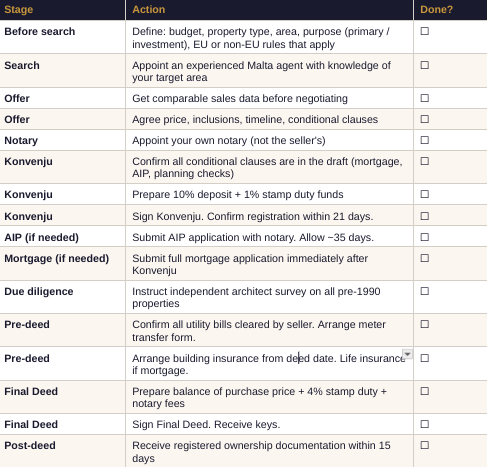
Malta Property Buying Checklist — Print and Keep
[INTERNAL LINK: Buying property in Malta as a foreigner: complete guide]
[INTERNAL LINK: Malta property guide 2025: everything you need to know]
[INTERNAL LINK: AIP permit Malta: what it is and who needs one]
