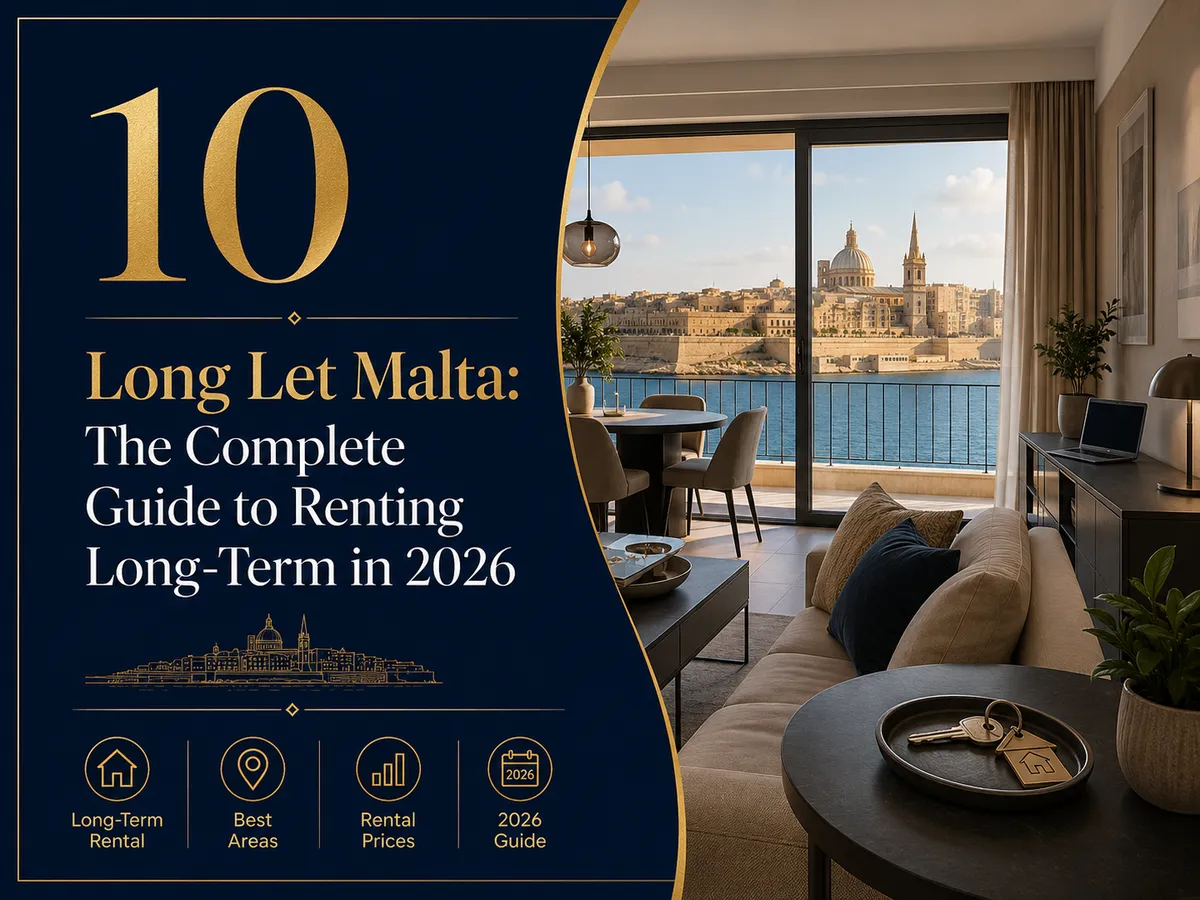
10 Long Let Malta: The Complete Guide to Renting Long-Term in 2026
10 Long Let Malta: The Complete Guide to Renting Long-Term in 2025
Renting long-term in Malta is not difficult. But it does require knowing a few things that most "Malta rental guides" skip over — like why the same apartment can be €300 cheaper five streets back from the seafront, which areas will leave you car-dependent and which ones will not, and what the law says about deposits, rent increases, and what your landlord can and cannot do.
We are Alliance by Let Buy Mark — a team of expats who moved to Malta ourselves and have since completed over 1,000 property transactions helping people do the same. This guide is the version we wished someone had handed us on arrival: specific, honest, and written by people who actually live here.
What Counts as a Long Let in Malta?
In Maltese property law, a long let — formally called a Private Residential Lease (PRL) — is any residential rental contract with a duration of one year or more. Long lets are distinct from short lets (maximum six months, for non-residents or temporary workers) and holiday lets (licensed tourist accommodation).
The one-year minimum is not just convention — it is legally required. A landlord cannot offer a long-let contract for less than twelve months. In practice, most leases run for one or two years, with annual renewal options and built-in rent review clauses.
Why does this matter to you as an expat or nomad? Because the long-let framework in Malta is regulated by the Private Residential Leases Act, which gives you specific protections that unregistered or holiday-let arrangements do not. Those protections include capped deposits, capped annual rent increases, mandatory notice periods, and dispute resolution through the Housing Authority's Adjudicating Panel.
THE RULE ON SHORT LETS VS LONG LETS If you plan to stay in Malta for more than six months, a long let is your only legal option for a residential lease. Short lets are specifically for non-residents employed or studying for under six months. If a landlord offers you a 'short let' contract for a longer stay, they are not complying with the Private Residential Leases Act and you would have no legal protection if a dispute arose.
What Does a Long Let Actually Cost in Malta? Rents by Area (2025)
Malta's rental market has seen significant change since 2021, when rents surged 28% from their COVID-era trough. Growth has moderated sharply to around 2%–3% annually as of mid-2025. Here is what you are realistically looking at across the main areas, based on current market listings and Housing Authority data.
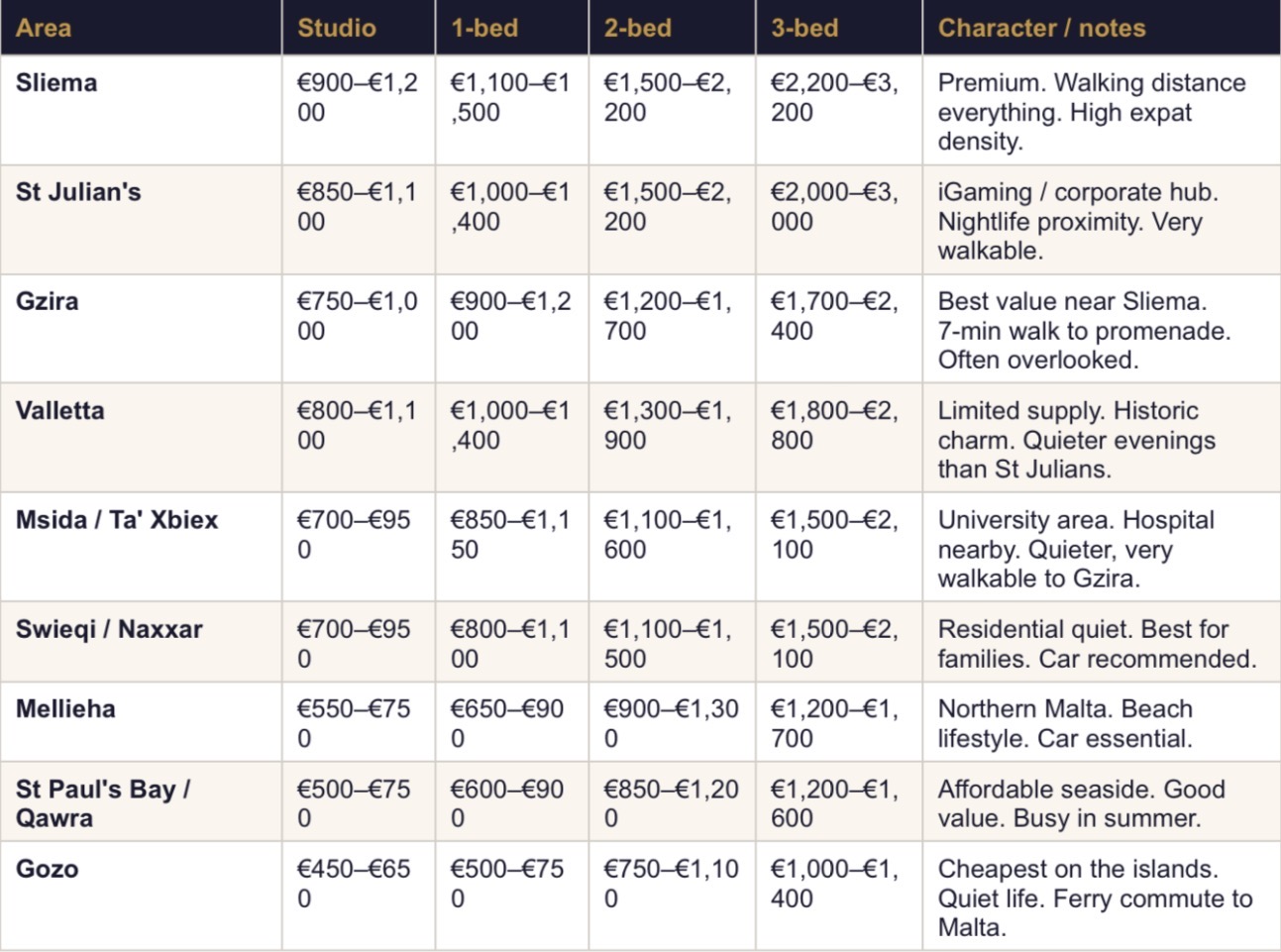

Sources: FreeMalta.com January 2026, Housing Authority Malta 2024 Annual Report, Alliance by Let Buy Mark market data.
THE GZIRA INSIGHT Gzira is the market's best-kept open secret for expats. It is a seven-minute walk from Sliema's promenade, ten minutes from the Valletta ferry, and on the main bus corridor to St Julian's. Apartments are 20%–35% cheaper than equivalent Sliema properties. Most people who move to Gzira say they stopped noticing the price difference from Sliema within a month. Most people in Sliema say they could not imagine living elsewhere. The question is which type of person you are.
Area Guide: Where Should You Actually Live?
The right area depends entirely on three things: what you are in Malta for, whether you have a car, and how much social life versus quiet you want. Here is the honest picture.
SLIEMA Premium coastal living
Rents: 1-bed: €1,100–€1,500 | 2-bed: €1,500–€2,200
Best for: Young professionals, expats who want everything on foot, vibrant restaurant/bar scene, seafront access, frequent buses. No car needed.
Watch out for: Expensive. High tourist density in summer. Can feel impersonal. Some buildings poorly maintained despite premium rents.
ST JULIAN'S The corporate and nightlife hub
Rents: 1-bed: €1,000–€1,400 | 2-bed: €1,500–€2,200
Best for: iGaming and tech workers, people who want 10-minute commutes to Paceville or Portomaso business cluster. Incredibly walkable.
Watch out for: Noisy, especially near Paceville. Some streets feel chaotic on weekends. Traffic is genuinely bad.
GZIRA The value play near Sliema
Rents: 1-bed: €900–€1,200 | 2-bed: €1,200–€1,700
Best for: Budget-conscious professionals wanting Sliema proximity. Good transport. Mixed local/expat community. Water polo clubs, local feel.
Watch out for: Not as glamorous as Sliema address. Some areas feel transitional. Parking difficult.
VALLETTA History and character
Rents: 1-bed: €1,000–€1,400 | 2-bed: €1,300–€1,900
Best for: People who want to live inside a UNESCO World Heritage city. Unique architecture. Restaurant and cultural scene. Quiet evenings.
Watch out for: Limited supply means competition is fierce. Older building stock — check for damp, lifts, condition. Parking essentially impossible.
MELLIEHA / NORTH MALTA The lifestyle choice
Rents: 1-bed: €650–€900 | 2-bed: €900–€1,300
Best for: Families, remote workers who want beach access without crowds. Genuinely beautiful area. Lower cost of living.
Watch out for: Car is not optional — it is essential. Limited nightlife. Can feel isolated for younger expats.
GOZO The alternative base
Rents: 1-bed: €500–€750 | 2-bed: €750–€1,100
Best for: Remote workers, retirees, lifestyle seekers who want peace, space, and a slower pace. Best value on the islands by far.
Watch out for: Ferry dependency to Malta (30 min crossing, can be affected by weather). Limited professional networking. Less English-language community infrastructure.
Want a tailored recommendation based on where you work, your budget, and what you want from Malta life? The Alliance by Let Buy Mark team can advise — letbuymark.com
Your Legal Rights as a Long-Let Tenant in Malta
Malta's Private Residential Leases Act (2020, amended 2024) is genuinely one of the more protective residential tenancy frameworks in the EU. Understanding what it gives you — and what it does not — is the most important thing you can do before signing anything.
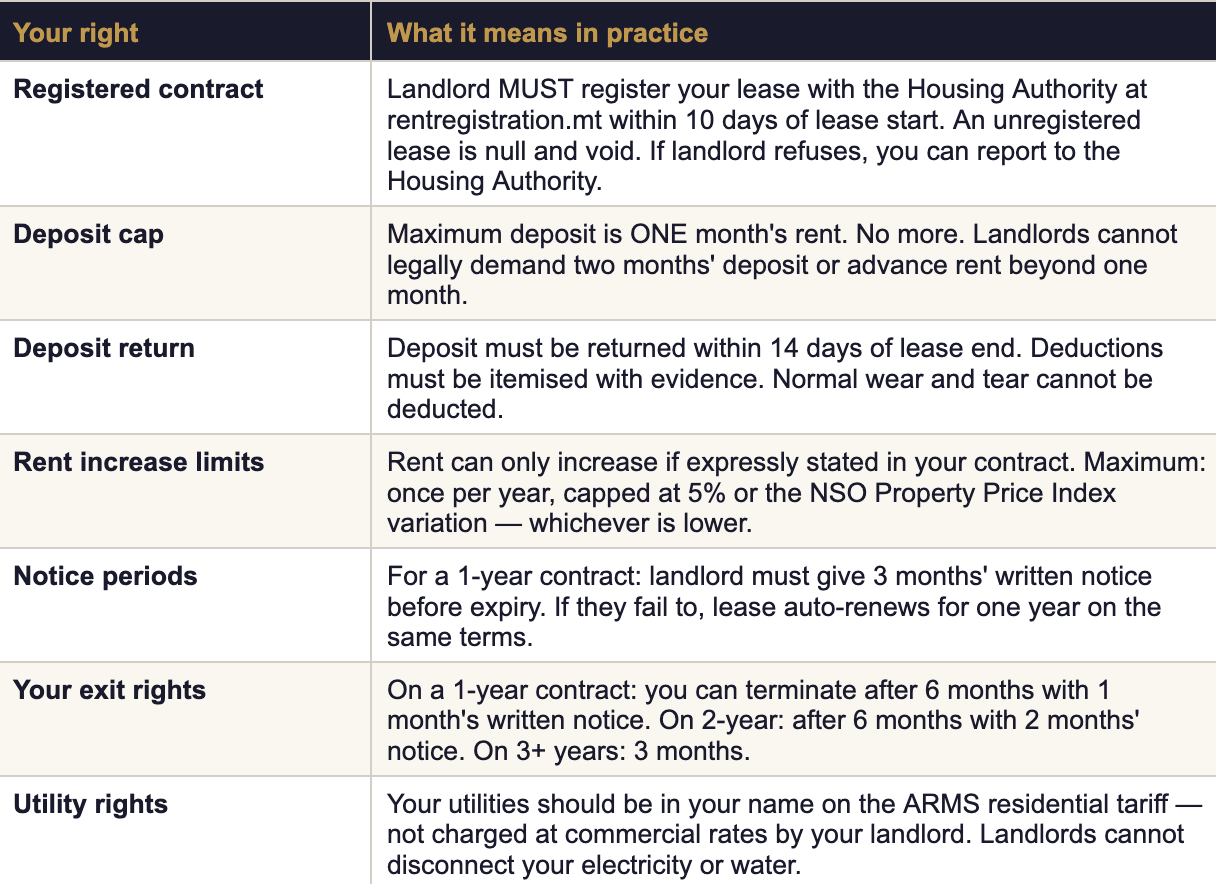

Note Update (Your Exit right): When you sign a 2 years contract, the mandatory stay is 9 months if its 3 years contract it is 12 months.
REGISTER YOUR CONTRACT The single most important thing you can do when starting a Malta long let: make sure the lease is registered at rentregistration.mt within 10 days of your start date. An unregistered contract means no ARMS residential tariff, no Housing Authority protection, and your deposit is essentially unprotected. The landlord bears the legal obligation to register — but if they do not, you can report it to the Housing Authority and they will pursue registration on your behalf.
How to Rent Long-Term in Malta: Step by Step
STEP 1 Set your budget — including costs beyond monthly rent
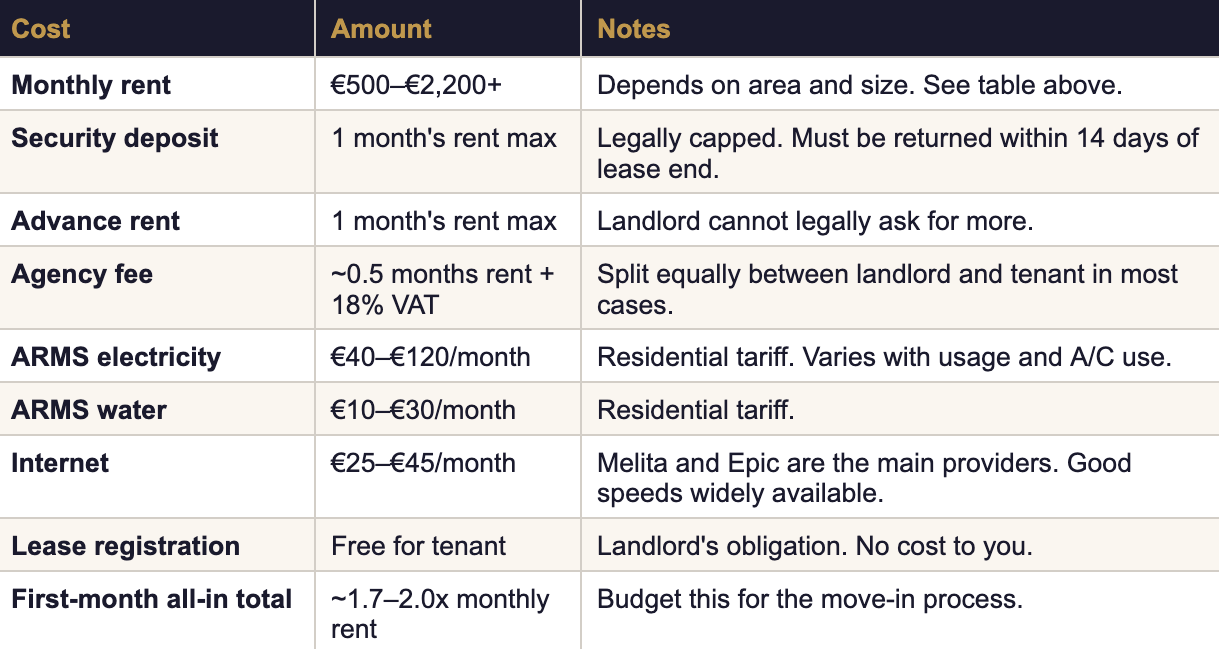
Monthly rent is not the only cost. Add: utilities (ARMS electricity and water typically €50–€120/month depending on usage), internet (€25–€45/month), agency fee (typically half a month's rent plus VAT — split with landlord), deposit (one month's rent). For a €1,200/month Gzira apartment, budget approximately €1,600–€1,700 for your first month all-in.
STEP 2 Find your property
The main platforms for Malta long lets: Maltapark.com, Djar.com.mt, PropertyMalta.com. Facebook groups remain active — 'Malta Accommodation Expats' moves quickly for well-priced listings. Working with a letting agent (like Alliance by Let Buy Mark) gives you access to off-market properties and takes the coordination burden off you, particularly if you are searching from abroad. Good properties in Sliema and Gzira let within one to three days. Have your documents ready before you view, not after.
STEP 3 Prepare your documents before viewing
What landlords typically request: valid passport or ID card, proof of income (employment contract, recent payslips, or — for freelancers and nomads — three months of bank statements and contracts with clients), reference from a previous landlord if available, and sometimes proof of address from your previous country. The stronger your documentation package, the faster you close. Some landlords will accept a guarantor if income documentation is limited.
STEP 4 View and negotiate
View at different times of day if possible. Check: natural light, ventilation, noise levels, condition of windows and doors, water pressure, air conditioning units (essential in summer), the building's common areas, and whether there is a lift if you are on a high floor. Negotiate on rent — asking prices carry 5%–10% negotiation margin in the current market, particularly for properties that have been listed for more than a few weeks.
STEP 5 Sign the lease and check every clause
Before signing, confirm: the lease term and start date are correct, rent amount and any review clause are explicit, deposit amount is clearly stated (and legal — maximum one month), utility arrangements are clear (are they in your name or the landlord's?), inventory of contents is attached and accurate, and there is a clause covering what happens at lease end. Do not sign a lease without a full inventory document — it is your protection against unjustified deposit deductions.
STEP 6 Register your address and set up utilities
After signing, the landlord registers the lease with the Housing Authority (rentregistration.mt) within ten days. You set up your ARMS account (arms.com.mt) to transfer electricity and water into your name at the residential tariff. For Identity Malta (if you are an EU citizen exercising free movement or a non-EU resident), you will need a registered rental address to complete your residency registration.
Full Cost Breakdown: What You Actually Need to Budget
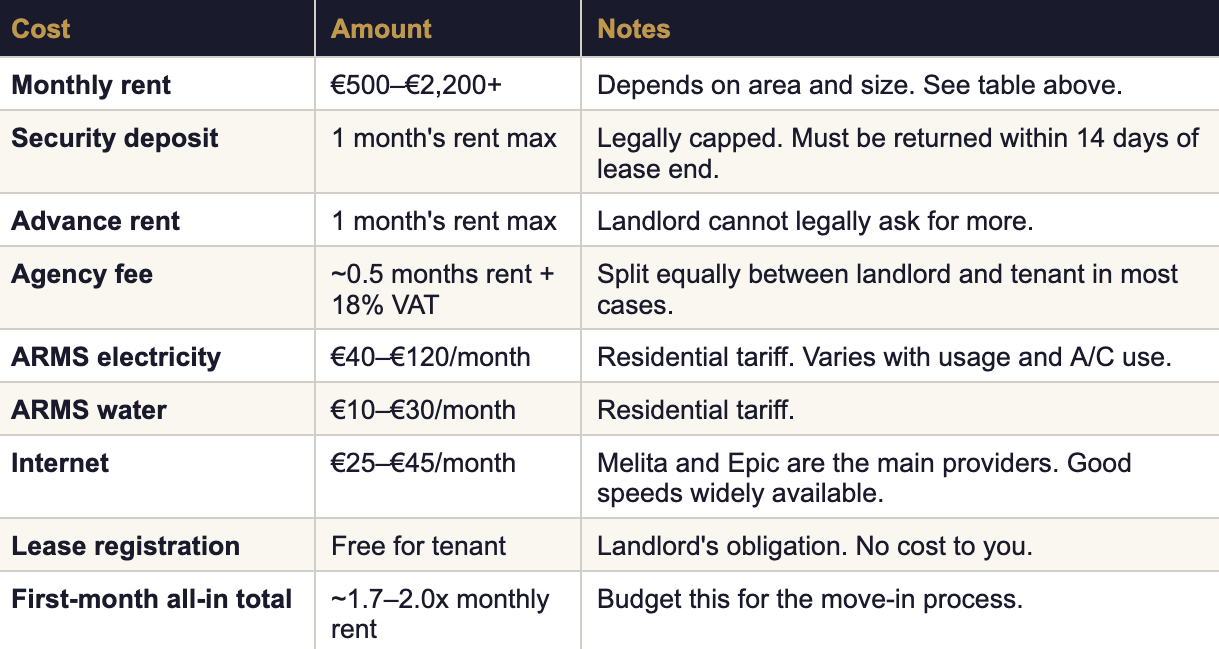
AGENCY FEES IN MALTA Under current practice, agency fees are typically split equally between landlord and tenant. On a €1,200/month apartment, each party pays approximately €600 + VAT (€708 total, €354 per side). Some listings are direct-from-owner with no agency fee. Facebook groups and platforms like Djar.com.mt include direct listings. Working with an agent does not always mean paying more — many good apartments only come through agents, and the time saved on coordination and negotiation frequently justifies the cost.
What Expats Get Wrong When Renting in Malta
Signing without an inventory
A signed inventory of all contents and their condition is your only protection against unjustified deposit deductions at the end of your tenancy. If your landlord does not provide one, create your own on arrival — photograph every piece of furniture, every wall, every appliance — and send it to your landlord in writing. Without this, a dispute about the deposit state becomes your word against theirs.
Not checking the ARMS tariff
Some landlords — particularly in older buildings or shared houses — charge tenants for electricity at commercial or inflated rates rather than passing through the ARMS residential tariff. This is illegal under the PRL Act. Your utilities should be billed through ARMS directly to you, at the residential rate. If a landlord insists on charging utilities as part of rent at a flat rate, ask them to justify it and compare it against actual ARMS bills for the property.
Choosing an area before visiting
The difference in feel between Sliema's promenade and a side street three blocks back is enormous. The difference between St Julian's by day and St Julian's on a Friday night is something you need to experience before committing to a 12-month lease. We strongly advise spending at least a long weekend in Malta — ideally staying in two different areas — before signing any long-let contract. Many expats who rush this decision regret the area more than the apartment.
Treating the asking price as fixed
Current market conditions favour tenants more than they did in 2022–2023. Rent growth has slowed to 2%–3%. Properties that have been listed for four weeks or more carry genuine negotiation room, typically 5%–10%. Come with a comparison of similar properties in the area, be clear about your timeline, and ask. The worst outcome is the landlord says no.
Not having documents ready
Good properties in Sliema and Gzira list, get viewed, and are agreed within 24–72 hours during peak search periods (September–October and January–February). If you see something you want and you are waiting to assemble your documents, someone else will take it. Have your passport, income proof, and bank statements ready before you start seriously viewing.
Looking for a long let in Malta and want help from people who know every area and every building? Alliance by Let Buy Mark — 1,000+ transactions, 4.9-star rated, expat team. letbuymark.com
Long Let vs Short Let: Which One Do You Actually Need?
If you are staying in Malta for more than six months, a long let is both the legal requirement and the better financial deal. Monthly costs on a long let are typically 40%–60% lower than the equivalent short-let or serviced apartment. A furnished 2-bedroom apartment in St Julian's that rents long-let for €1,800/month will cost €3,000–€4,000/month on a short-let basis for the same quality and location.
Short lets make sense for: initial arrival periods before you have decided on an area (one to three months), employers bringing staff over for project-based work under six months, and students on short courses.
Long lets make sense for: anyone staying more than six months, digital nomads who want a base in Malta for a year or more, employees relocating with companies, expat families, and anyone who wants legal protection and utility stability.
[INTERNAL LINK: Short let Malta: when it makes sense and when it does not]
Ready to find your long let in Malta? The Alliance by Let Buy Mark team will match you with the right property in the right area — from your first enquiry to the day you get your keys. letbuymark.com
Long Let Malta: Quick Reference

[INTERNAL LINK: Malta expat property guide: everything you need to know before moving]
[INTERNAL LINK: Best areas to live in Malta: the honest guide]
[INTERNAL LINK: Cost of living Malta 2025: a realistic breakdown]
et your keys. letbuymark.com
