
5 Malta Property Guide 2026: Everything You Need to Buy, Invest or Relocate
5 Malta Property Guide 2025: Everything You Need to Buy, Invest or Relocate
Malta is a 316 square kilometre island in the middle of the Mediterranean. It has been a Phoenician trading post, an Arab emirate, a Knights Hospitaller stronghold, a British Crown Colony, and since 1964, an independent republic and EU member state. Its capital, Valletta, is a UNESCO World Heritage Site. English is an official language.
People have been fighting over this island for three thousand years. When you understand that history, Malta's property market makes immediate sense.
There is very little land. There is consistent, growing demand from locals and international buyers. There are no new coastlines to develop. And there is a government that actively courts foreign investment through residency programmes, tax incentives, and one of the most accessible property ownership frameworks in the EU.
This guide covers everything you need to know about the Malta property market in 2025 — whether you are buying a home, building an investment portfolio, or planning a relocation. We have drawn on our own transaction data from January 2017 to February 2026, the KPMG-MDA Construction Industry and Property Market Report 2025, NSO Malta, and the Central Bank of Malta.
WHO WE ARE Alliance by Let Buy Mark is a Malta-based real estate agency run by experienced expats. We have completed over 1,000 transactions across residential sales, lettings, and commercial property. We carry 4.9-star reviews because we give clients the full picture — including the parts other agents leave out. This guide is an example of how we work.
1. The Malta Property Market in 2025: The Numbers That Matter
The total value of Promise of Sale agreements registered across Malta and Gozo in 2025 reached €5.96 billion — the highest annual figure on record. Average transaction value hit €333,358, up from €201,023 in 2017. That is a 65.8% increase in eight years. By January and February 2026, the market was already tracking 7.8% ahead of the same period the previous year.
These are not headline statistics sourced from a press release. They are our own data, extracted from the full register of Promise of Sale agreements from January 2017 to February 2026. We publish them here because we think buyers deserve to see the actual trajectory of the market, not a smoothed approximation of it.
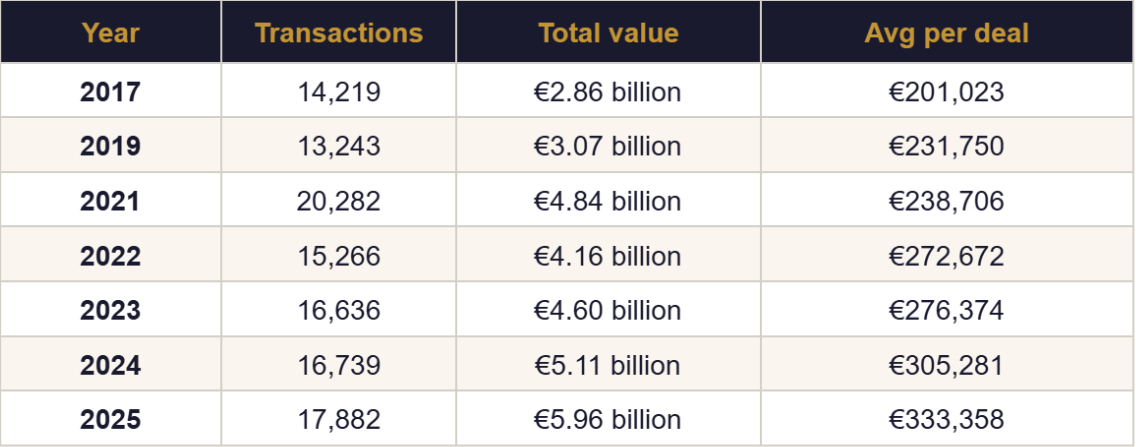
The average price per square metre across Malta sits at approximately €3,300 nationally, rising to €4,500–€6,500 per sqm in Sliema and St Julian's, and up to €7,500 per sqm for prime character property in Valletta. Entry-level one-bedroom apartments start from €180,000 in Gozo and the south. Average apartments in Sliema and St Julian's trade from €350,000 to €600,000+.
[INTERNAL LINK: Malta property prices 2025: what you'll actually pay and why]
2. Can Foreigners Buy Property in Malta?
Yes. The short answer — and the reassuring one — is that Malta is genuinely open to foreign buyers. Over 30% of all property transactions in Malta currently involve non-Maltese buyers. The rules differ depending on your nationality and what you intend to buy.
EU citizens
If you are an EU national who has resided continuously in Malta for five years or more, you have no restrictions whatsoever. You can buy as many properties as you like, in any location, for any purpose. If you have not yet reached five years of continuous residency, you can still buy one property for personal use without a permit. For a second property or investment purchase outside a Special Designated Area (SDA), you will need an AIP permit (see below).
Non-EU nationals (third-country nationals)
If you are from outside the EU — the Middle East, South Africa, the US, Asia — you can absolutely buy property in Malta. Outside of SDAs, you will need an Acquisition of Immovable Property (AIP) permit from the Ministry of Finance. The fee is €233. The process typically takes 35 days. The AIP route restricts you to one property for personal residential use.
The AIP requirement disappears entirely if you buy within a Special Designated Area — see Section 4 below.
POST-BREXIT UK BUYERS British nationals are treated as non-EU (third-country nationals) for property purchase purposes since Brexit. UK buyers who have not lived in Malta for five continuous years will need an AIP permit to purchase outside an SDA, and are restricted to one property for personal use. Buying within an SDA removes all restrictions.
[INTERNAL LINK: Buying property in Malta as a foreigner: the complete guide]
3. The Malta Property Buying Process: Step by Step
Malta's property purchase process is structured, legally sound, and — with the right people around you — refreshingly straightforward. The notary public is the central figure. They are a government-appointed official who manages due diligence, contract preparation, stamp duty payment, and title registration on behalf of both parties.
STEP 1 Appoint an agent and define your brief
Before viewing a single property, define what you are actually buying: residential home, investment, residency-linked purchase, or renovation project. Your agent should match properties to your specific criteria — not just your budget. At Alliance by Let Buy Mark, we spend time understanding your goals before we show you a single listing. Many of our best deals come from off-market introductions.
STEP 2 Appoint your notary
The buyer typically appoints the notary in Malta. This is your most important professional appointment. Your notary acts in your legal interest throughout the process — conducting title searches, checking planning permits, handling AIP applications, and preparing both the Konvenju and the Final Deed. Choose a notary with specific residential property experience, not a general practitioner who handles property occasionally.
STEP 3 Make an offer and agree terms
Once you have identified a property, your agent negotiates the price and terms on your behalf. In Malta, asking prices typically carry a 10%–18% negotiation margin. Coming with comparable transaction data — which we provide as standard — gives you leverage. Agree not only on price but on the Konvenju timeline, any fixtures included, and any conditional clauses.
STEP 4 Sign the Konvenju (Promise of Sale)
The Konvenju is a binding preliminary agreement. At signing, the buyer pays 10% of the purchase price as a deposit, plus 1% of the total 5% stamp duty. The Konvenju period — typically three to six months — is the window in which your notary conducts all legal checks and in which AIP permits (where required) are applied for and granted.
STEP 5 Due diligence and AIP period
Your notary conducts a full title search at the Public Registry and Land Registry, checks for any mortgages or hypothecs, verifies planning permits and building permissions, and confirms boundary lines. For non-EU buyers outside SDAs, the AIP application is submitted during this period. Do not rush this stage. It is your protection.
STEP 6 Arrange financing if required
Malta's mortgage market is dominated by Bank of Valletta and HSBC Malta, which together account for around 66% of retail lending. Foreign buyers can access mortgages, though terms differ from residents: expect a 25%–35% deposit requirement and mortgage rates currently in the 3.5%–5.5% range depending on applicant profile and bank. There is no annual property tax in Malta, which meaningfully improves the net return calculation for leveraged investors.
STEP 7 Sign the Final Deed of Sale
Once all searches are clear, permits are in order, and financing is confirmed, the Final Deed is signed in the presence of your notary. The remaining 4% stamp duty is paid here, along with the balance of notary fees and the purchase price balance. Your notary registers the deed with the Public Registry. Ownership transfers to you. You receive the keys.
TIMELINE A straightforward purchase from Konvenju to Final Deed typically takes three to six months. Complex purchases — those involving AIP permits, heritage properties, unrenovated buildings, or mortgage financing from non-Maltese lenders — can take six to nine months. Plan accordingly. Do not give notice on your current accommodation until the Final Deed date is confirmed.
[INTERNAL LINK: Malta property buying process: step by step]
Want to walk through the process with an agent who has done it over 1,000 times? Book a free consultation with Alliance by Let Buy Mark — letbuymark.com
4. Special Designated Areas (SDAs): Why They Matter
Special Designated Areas are government-designated developments where all property ownership restrictions for non-Maltese buyers are removed. No AIP permit. No one-property limit. No personal-use restriction. You can buy multiple properties in SDAs and rent them out freely, including on a short-let basis.
SDAs are also where Malta's most premium new-build developments are concentrated. They typically offer concierge services, private parking, pools, high-specification finishes, and secure ownership structures that appeal to international buyers who want minimal administrative complexity.
New SDA developments continue to receive government approval. If you are a non-EU buyer who wants maximum flexibility, buying within an SDA is the most straightforward route. Prices in prime SDAs like Portomaso and Tigne Point range from €5,000 to €9,000 per sqm for premium units.
[INTERNAL LINK: Special designated areas Malta: where foreigners can buy freely]
5. What Does It Actually Cost? Full Breakdown
One of the most common mistakes buyers make in Malta is budgeting only for the purchase price. The full acquisition cost is meaningfully higher. Here is the complete picture.
On a €500,000 purchase, a buyer's total acquisition cost — excluding the purchase price — runs approximately €40,000–€50,000. Budget 8%–10% on top of the purchase price as a reliable rule of thumb.
FIRST-TIME BUYER BENEFIT If you are buying your first property in Malta and it will be your primary residence, you are exempt from stamp duty on the first €200,000 of the purchase price — a saving of up to €10,000. This applies to both Maltese and foreign buyers. The scheme has been extended through the end of 2025 and is expected to continue.
[INTERNAL LINK: Malta property stamp duty, notary fees, and all purchase costs explained]
6. Best Areas to Buy in Malta: A Practical Overview
Malta is small — you can drive across the entire island in under an hour. But the variation in price, lifestyle, and investment characteristics between areas is enormous. Here is a working summary.
Sliema and St Julian's — the premium benchmark
Malta's most in-demand residential and investment area. Sliema offers seafront promenades, established expat community, excellent amenities, and the highest property prices on the island outside Valletta's character stock — €4,500–€6,500 per sqm. St Julian's adds nightlife, restaurants, and the Portomaso and Paceville business cluster. Both areas offer strong short-let demand. Buy-to-let investors get the most reliable liquidity here for resale.
Valletta — the capital's unique market
UNESCO heritage status and finite supply make Valletta the market's most distinctive sub-segment. Finished apartments start at €280,000. Character conversions and palazzo restorations can reach €3 million+. Short-let yields of 4%–5.5%. Strong capital appreciation. Not suitable for buyers wanting new-build ease — this is a market for those who understand what historic fabric is worth long-term.
Mellieha and the north — lifestyle and growth
Larger properties, sea views, lower prices than the north harbour. Families, remote workers, and lifestyle buyers have driven strong price growth here over the past four years. Still offers better value relative to its location quality than the central areas. Good trajectory.
Gozo — the alternative
Malta's sister island. Quieter, greener, more traditional. Farmhouses are Gozo's signature property type — stone construction, large footprints, outdoor space, and genuine character at prices well below equivalent mainland Malta properties. A growing remote-worker and retirement buyer base is increasing demand year on year.
Swieqi, Naxxar, St Paul's Bay
Secondary but well-established residential areas popular with expat families and working professionals. Better value per sqm than Sliema, good school access, commutable to the business districts. Solid long-let rental demand from corporate tenants and iGaming industry employees.
[INTERNAL LINK: Best areas to live in Malta: the honest guide]
[INTERNAL LINK: Malta vs Gozo property: a side-by-side comparison]
7. Residency Through Property: Your Options
Malta is one of the few EU countries where a single property purchase can unlock a legal pathway to European residency. This is a major driver of international buyer demand, and it is worth understanding exactly what is available.
Malta Permanent Residency Programme (MPRP)
Requires a property purchase of at least €300,000 (€375,000 in the north of Malta or Gozo), plus a government contribution of €28,000 (€58,000 in certain areas) and charitable donation of €2,000. The MPRP grants EU permanent residency to the main applicant, spouse, children, and parents. No minimum stay requirement. Full Schengen access. No nationality restrictions. This is the programme most commonly used by our non-EU investor clients.
Malta Global Residence Programme (GRP)
A tax residence programme. Requires a property purchase of €275,000+ (€220,000+ in the south of Malta or Gozo), or a rental agreement meeting the minimum threshold. Grants beneficial tax status with a flat 15% rate on foreign income remitted to Malta, with a minimum annual tax of €15,000. Primarily used by HNWIs seeking tax optimisation alongside Maltese residency.
Nomad Residence Permit
For remote workers and digital entrepreneurs. Does not require a property purchase, but many permit holders choose to rent or buy in Malta once settled. Income requirement of €2,700/month net. Popular with European, American, and British remote workers.
OUR EXPERIENCE The majority of our non-EU investor clients are using the MPRP as their primary reason for purchasing. The sweet spot in our transaction book is a €450,000–€800,000 purchase in Sliema, St Julian's, or a premium development — MPRP-qualifying, good rental income potential, and strong long-term capital growth prospects. We coordinate the property side with specialist immigration advisers to make the process seamless.
[INTERNAL LINK: Malta permanent residency scheme: the complete guide]
[INTERNAL LINK: Malta golden visa: what it is and how to qualify]
8. Malta Property as an Investment: The Return Case
Malta is not a high-yield market in the way that some emerging European markets are. It is a stable, appreciating, low-risk market — and those characteristics matter more to the type of buyer who comes to Malta than raw yield percentages.
Malta has no annual property tax — a significant structural advantage over comparable European markets. A €500,000 apartment in Sliema generating €22,000 per year in long-let rental income pays zero annual property tax. The same property in Lisbon, Barcelona, or Cannes would carry an annual tax liability of €2,000–€8,000 depending on the jurisdiction. Over a 10-year hold, that difference compounds materially.
[INTERNAL LINK: Rental yield in Malta: which areas perform best?]
[INTERNAL LINK: Why invest in Malta: 7 reasons backed by data]
Ready to start your Malta property journey? Alliance by Let Buy Mark — 1,000+ completed transactions, 4.9-star rated, expat experts who have been through the process ourselves. Book a free consultation at letbuymark.com
9. Common Mistakes Malta Property Buyers Make
In over a thousand transactions, we have seen the same mistakes come up repeatedly. Here are the ones that matter most.
Skipping the independent structural survey
Malta has a large volume of older building stock — some of it in excellent condition, some of it concealing serious structural or damp issues behind a fresh coat of paint. An independent architect's survey before or during the Konvenju period is not expensive and can save you from a very expensive problem post-purchase. Never skip it on a property built before 1980.
Using the seller's notary
It is legally permitted. It is also a conflict of interest. Your notary should be appointed by you and working exclusively for your interests. This matters especially for non-EU buyers unfamiliar with Maltese property law, where the nuances of title, permit compliance, and ground rent can be material.
Not checking ground rent (cens)
Some older Maltese properties are held on enfiteusi — a form of long-term leasehold where the buyer pays an annual ground rent (cens) to the original owner or their heirs. This is not the same as freehold ownership and can complicate resale. Your notary will identify this during searches. Make sure you ask about it directly.
Rushing the timeline to save costs
Some buyers try to compress the Konvenju period to save on holding costs or to meet a self-imposed deadline. The due diligence period exists to protect you. A missed title issue, an unpermitted extension, or an unresolved AIP complication discovered after the Final Deed is signed is far more expensive than six weeks of patience.
Buying in Malta without seeing it first
We support buyers who cannot travel frequently and can complete much of the process remotely via power of attorney. But we always recommend at least one visit — ideally two — before committing to a purchase. Malta is a small island, but the difference in feel between a property on a busy arterial road and one on a quiet residential street can be enormous. Photographs do not capture it.
10. Why Work With Alliance by Let Buy Mark?
There are dozens of real estate agencies in Malta. Here is what makes us different, stated plainly.
We are expats who bought property in Malta ourselves. We went through the AIP process, the notary searches, the Konvenju negotiations, and the final deed — as buyers, not just as agents. We know what the process feels like from your side of the table, because we have been on that side.
Our team has completed over 1,000 transactions — residential sales, commercial lettings, long-let management, and MPRP-linked purchases. Our 4.9-star review average reflects the fact that we tell clients the truth: when a property is overpriced, when a building has management issues, when an area does not match the buyer's stated priorities, and when a deal is genuinely worth moving quickly on.
We do not disappear after the Konvenju. We stay with you through every stage — coordinating with your notary, managing the AIP application, liaising with the seller's agent, and being available when questions arise. Because they always do.
Book your free Malta property consultation today. No sales pressure, just straight answers from people who know the market. letbuymark.com
