
9. Rental Yield Malta 2026 Area-by-Area Guide for Serious Investors
9 Rental Yield Malta 2026: Area-by-Area Guide for Serious Investors
The yield conversation in Malta needs to start with an honest statement that most marketing brochures skip:
Malta is not a high-yield market. If you are comparing it to emerging market real estate or distressed European assets, the gross numbers will disappoint you. The national average gross rental yield sits at 3.92% as of Q1 2026. Net, after the 15% rental income tax, management fees, service charges, and vacancy allowance, you are typically looking at 2.0%–2.5%.
That is the truth. And it is also incomplete — because yield is only one dimension of return in a market that has delivered 65.8% average transaction value growth from 2017 to 2025, carries zero annual property tax, and offers the only EU permanent residency programme in Southern Europe with a clear, functioning pathway for non-EU investors.
Understanding rental yield in Malta means understanding where the numbers are strong, where they are weak, why the gap exists, and how to build a strategy around what the market actually offers — not what it is often sold as.
This guide covers all of it, area by area, with data from Global Property Guide (Q1 2026), Airbtics short-let data, Expatax Malta market analysis, and our own transaction records.
OUR POSITION Alliance by Let Buy Mark has completed over 1,000 Malta and Gozo property transactions. We tell investors the yield their property will actually generate — gross, net, and in context. What follows is how we brief every investor client before they commit.
The Headline Numbers: Malta Rental Yields in 2026
The average gross rental yield across Malta is 3.92% as of Q1 2026, according to Global Property Guide's biannual analysis of median rents and purchase prices across all major areas. This is up from 3.66% in Q2 2023 — a meaningful improvement — but slightly below the Q2 2025 peak of 4.05%, as rising property prices have outpaced rent growth in some areas.
The spread between Malta's highest and lowest-yielding areas is enormous: from 1.15% gross in Valletta at the bottom to 4.44% gross in St Julian's at the top. That near-fourfold difference between postcode choices illustrates why area selection is far more important than national averages when building a Malta rental portfolio.
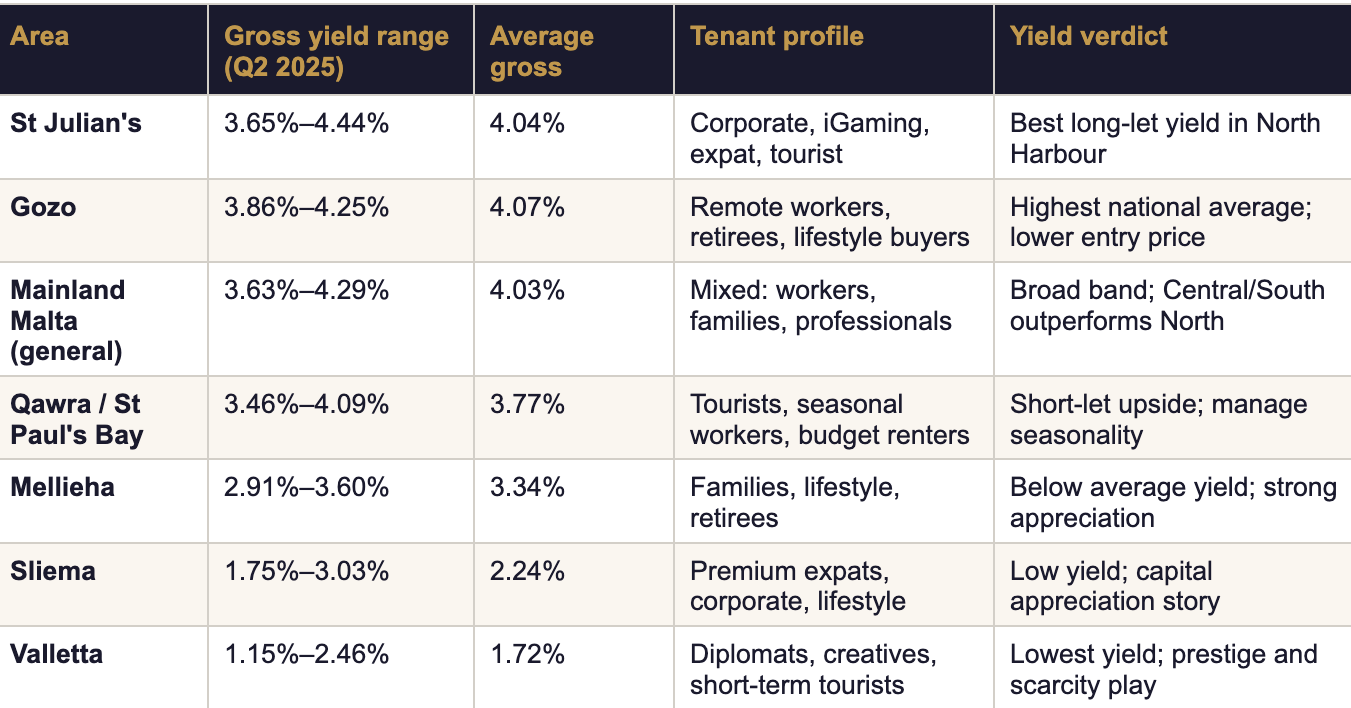
Source: Global Property Guide Q2 2025 / Q1 2026 biannual yield analysis. Figures are gross yields on apartments.
WHAT THIS TABLE REALLY MEANS The areas with the highest purchase prices — Valletta, Sliema — have the lowest yields. The areas with the most accessible entry prices — Gozo, Central Malta — have the highest yields. This is yield compression in action: when prices rise faster than rents, gross yield falls. Sliema's price per sqm has risen ~73% since 2020 while rents grew ~28%. The yield gap is not a market failure — it is a signal about what Sliema buyers are actually paying for: capital appreciation and liquidity, not income.
[INTERNAL LINK: Malta property investment return: real yields, tax, and what to expect]
From Gross to Net: The Numbers After Costs
The gross-to-net yield gap in Malta runs approximately 1.5 to 2.0 percentage points. On a 4.04% gross yield in St Julian's, your net yield is realistically 2.0%–2.5%. Here is every cost that creates that gap, with realistic figures.
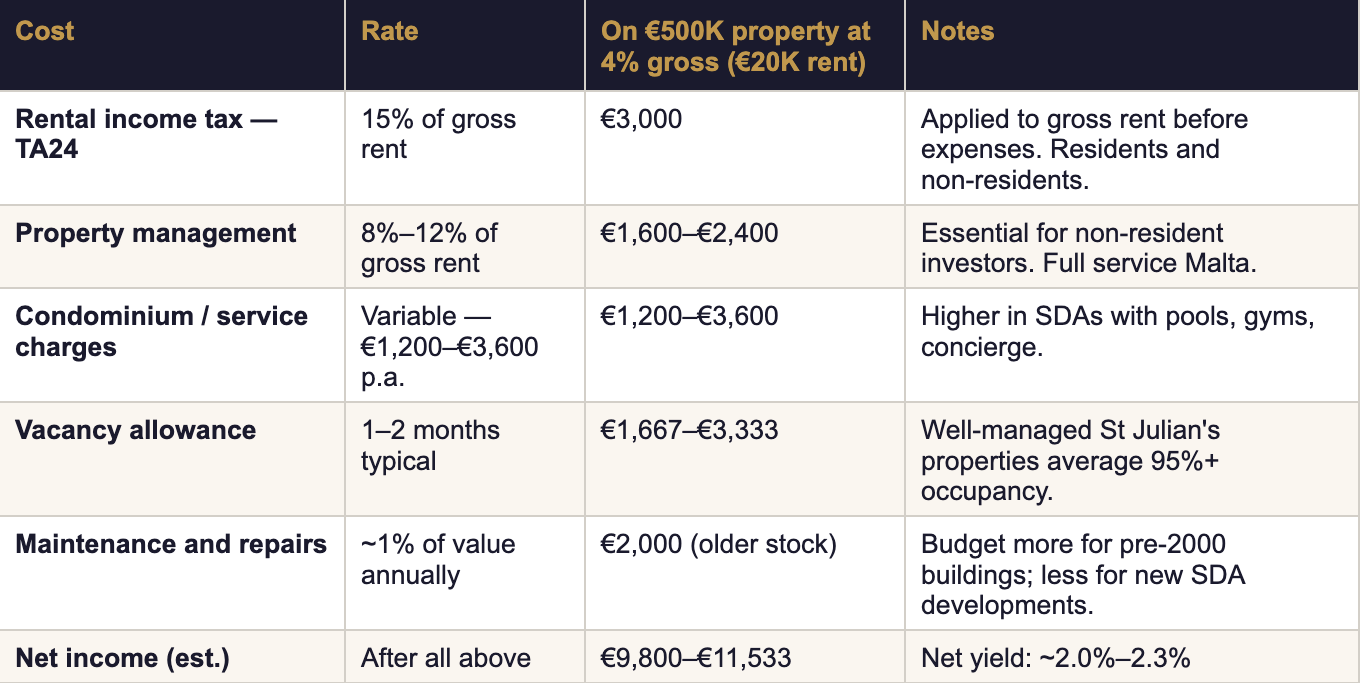
THE TA24 RULE EVERY INVESTOR MUST KNOW Malta's 15% flat tax on gross rental income (filed via TA24 form, due 30 April each year) applies to both residents and non-residents. It is calculated on gross rent — the total amount collected from your tenant before any expenses. If your tenant pays €1,800 per month, you owe €270 in TA24 tax that month, regardless of what the property costs you to run. No deductions are permitted under this route. It is simple, predictable, and — compared to marginal rate taxation in most European countries — genuinely competitive.
[INTERNAL LINK: Rental income tax Malta: how TA24 works for property investors]
Long-Let vs Short-Let: Where Is the Yield Actually Better?
This is the question every Malta investor eventually asks. And the honest answer, backed by 2025 data, is nuanced.
The average annual short-let (Airbnb/Booking.com) revenue across Malta was €30,000 in the twelve months to October 2025, with a median occupancy rate of 79% and an average daily rate of €112, according to Airbtics. In St Julian's specifically — the market's premier short-let location — average annual STR revenue was €35,924 at 80% occupancy and €133 ADR.
Compare that to long-let: a well-positioned 2-bedroom apartment in St Julian's rents for €1,800–€2,200 per month on a long-let. Annual gross: €21,600–€26,400. On the same property, a well-managed short-let at 80% occupancy generating €133/night produces approximately €38,000–€42,000 annually in peak performance — but with meaningfully higher management complexity, VAT registration requirements for licensed short-lets, and higher operational costs.
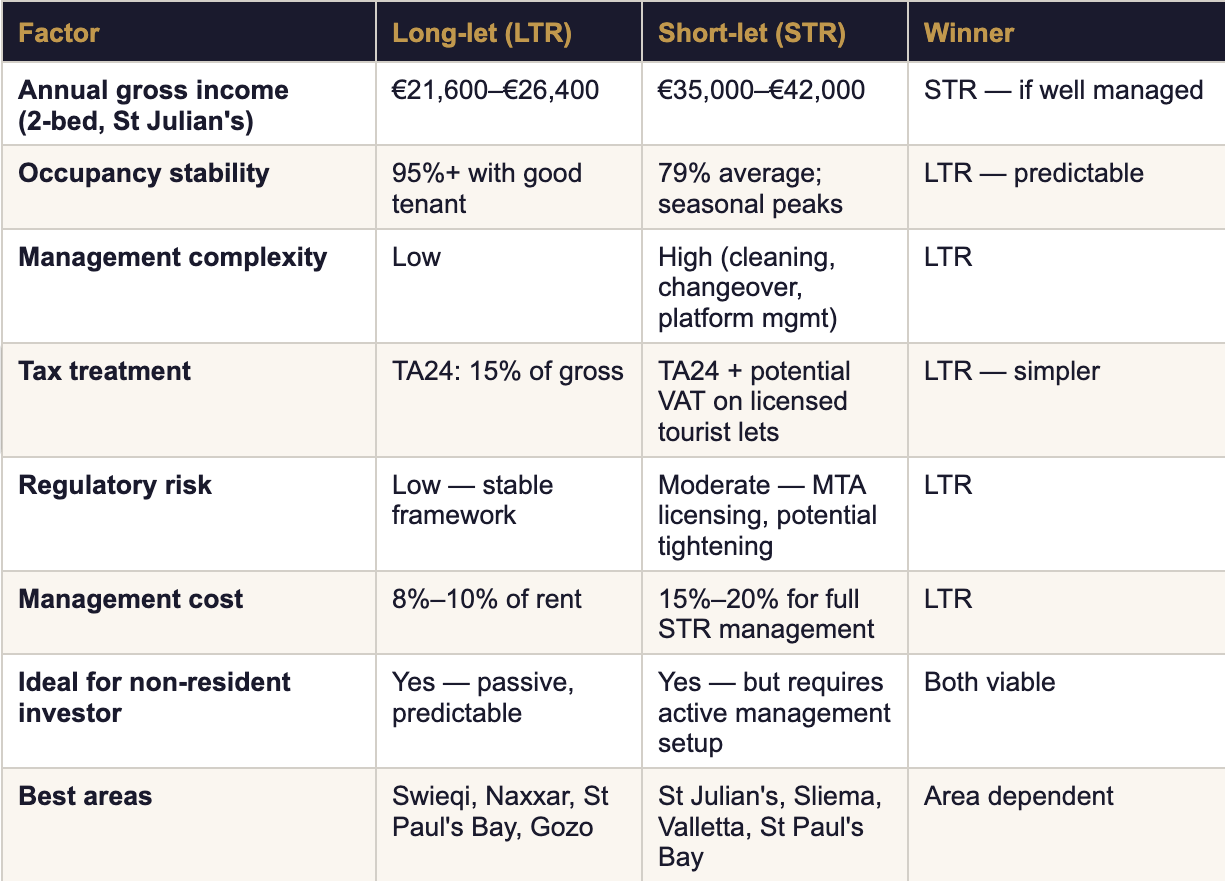
The research is clear: a well-run short-let in the right location outperforms long-let income — but the breakeven point is lower than most investors realise. In Gozo, according to Expatax Malta's 2025 analysis, a 1-bedroom property only needs to be booked for 47 nights per year to match long-let income at 90% occupancy. In St Julian's, that breakeven is around 90–100 nights — less than one good summer season.
The question is not which strategy yields more on paper. It is which strategy you can actually execute from a distance, with the management infrastructure you have in place.
OUR RECOMMENDATION FOR NON-RESIDENT INVESTORS For buyers who will not be based in Malta, a long-let strategy with a reputable property management company is almost always the right starting point. It is predictable, lower-risk, and requires minimal hands-on involvement. Short-let can be added as a layer later, once you know the property and have the right management relationship. Starting with short-let from overseas without a trusted on-the-ground operator is the fastest route to underperformance.
Area-by-Area Yield Verdicts: Where to Buy for Rental Income
ST JULIAN'S — BEST LONG-LET YIELD IN THE NORTH HARBOUR ★★★★☆ Yield + liquidity
Gross yield average 4.04% (Q2 2025). Best corporate and expat long-let demand in Malta. Portomaso and surrounding developments attract senior iGaming and finance professionals on 12–24 month leases. Two-bedroom apartments rent at €1,800–€2,200/month. Short-let revenue averages €35,924/year at 80% occupancy. Entry from €380,000 for a well-positioned 2-bed. Best for: long-let corporate tenants; short-let as secondary strategy. Ownership: buy in an SDA (Portomaso, Pender Gardens) for full rental freedom with no AIP restrictions.
GOZO — HIGHEST GROSS YIELD IN MALTA ★★★★★ Yield (gross)
Gross yield average 4.07% (Q2 2025). Lower entry prices (2-bed apartments from €200,000–€280,000) support stronger yield metrics despite lower absolute rents. Remote-worker demand is growing steadily, particularly for furnished mid-range apartments. Short-let breakeven of just 47 nights in Gozo — the lowest in Malta — makes it particularly suited to investors who want to occupy the property themselves during summer and still generate meaningful income in the remainder of the year. Connectivity improving: new sea transport links in procurement. Best for: yield-focused investors with medium-term horizon; lifestyle investors who plan to use the property part-year.
CENTRAL AND SOUTH MALTA (Marsaskala, Żabbar, Mosta, Birkirkara) ★★★☆☆ Yield + stability
Apartment yields in central and southern areas sit at the higher end of the mainland Malta average: 3.6%–4.3% gross. Tenant base is predominantly Maltese nationals, foreign workers in manufacturing and logistics, and budget-conscious expats. Less competition from tourist demand. Rents are lower in absolute terms (1-bed: €700–€950/month) but purchase prices are proportionally lower still. Long-let occupancy rates are consistently high. House (villa/townhouse) yields are weaker here — national house average is only 2.5% gross, with North Malta dropping to 1.8%. Stick to apartments in this segment.
SLIEMA — CAPITAL APPRECIATION, NOT INCOME ★★☆☆☆ Yield | ★★★★★ Capital growth
Gross yield average 2.24% (Q2 2025) — the second lowest in Malta. Prices surged 73% since 2020 (from ~€375,000 to ~€650,000 median for a 2-bed). Rents grew at roughly a third of that rate. The yield math does not work for a pure income play. What it does offer: Malta's deepest resale market, the strongest brand recognition with international buyers, and the most liquid resale conditions on the island. Corporate and diplomatic long-let tenants provide reliable occupancy at €1,800–€2,500/month for well-finished 2-beds. Buy Sliema for capital and liquidity, not yield.
VALLETTA — PRESTIGE AND SHORT-LET POTENTIAL, NOT GROSS YIELD ★☆☆☆☆ Gross yield | ★★★★★ Short-let premium
Gross long-let yield: 1.72% average — the lowest in Malta. But the Valletta short-let tells a different story. As a UNESCO World Heritage capital, it generates premium nightly rates: well-positioned apartments achieve €120–€200/night in peak season. Annual STR revenue on a good 2-bed can reach €28,000–€38,000. The challenge: MTA licensing is required for short-let, and 1 in 6 Valletta homes is already in the short-let market. Competition is real. For investors buying a Valletta character property for renovation and short-let, the return case is strong — but it requires patience, project management capability, and the right property. Not a passive investment.
QAWRA / ST PAUL'S BAY — SHORT-LET UPSIDE WITH SEASONAL RISK ★★★☆☆ Yield (seasonal)
Gross yield 3.77% average. The northern coast is Malta's most tourist-dense area outside the harbour regions. Short-let properties here can achieve strong peak-season occupancy but face meaningful low-season voids. The yield calculation depends heavily on your management quality and occupancy strategy in the October–March period. Strong infrastructure, accessible entry prices (2-bed from €220,000–€300,000), and solid year-round demand from budget-conscious long-term expats provide a base. Best strategy: hybrid approach — long-let October to April, short-let May to September, with a reliable local management company.
Want a yield projection for a specific area or property? Alliance by Let Buy Mark will model it with real numbers. letbuymark.com
Does Property Type Matter for Yield?
Yes — significantly. This is one of the clearest findings from 2025 Malta market data.
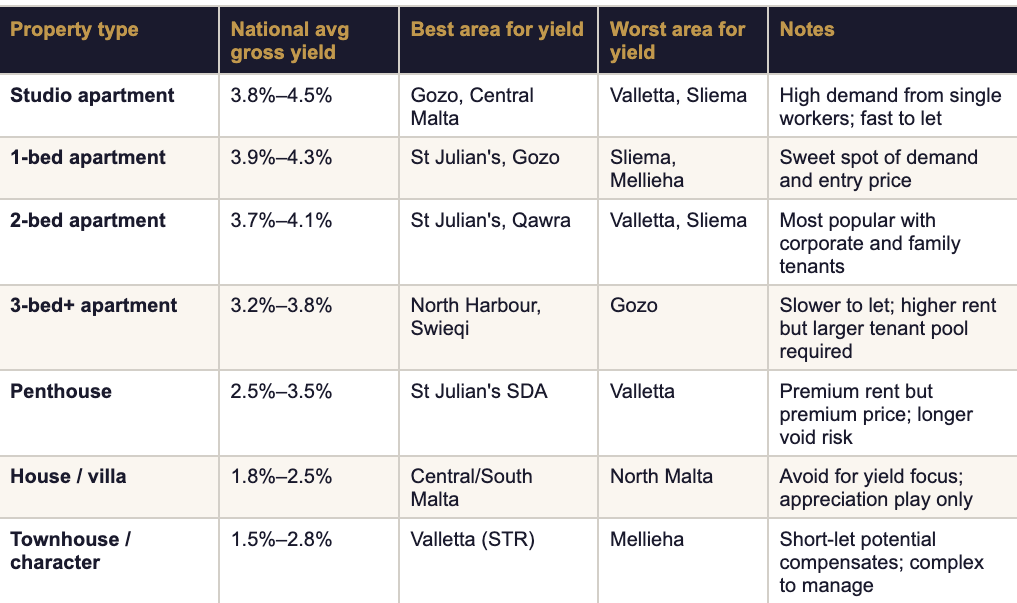
Apartments are the clear winner. National average apartment gross yield: 4.03%. National average house (villa, townhouse, house of character) gross yield: 2.5%. In North Malta, house yield drops to just 1.8% — the weakest segment in the entire dataset.
Why? House prices surged dramatically between 2020 and 2025 — in some areas by 70% — while rents on houses have not kept pace. Tenants who cannot afford house prices still cannot afford the rent levels required to justify those prices. Apartments, by contrast, have more liquid tenant demand, shorter void periods, and proportionally lower maintenance costs.
WHAT THIS MEANS FOR YOUR STRATEGY If your primary goal is rental yield, buy a 2-bedroom apartment. Not a villa. Not a townhouse. Not a house of character. Apartments have tighter yield distributions, faster void recovery, and the most active tenant market across all areas. The lifestyle premium of a Maltese villa is real — but it comes at a direct cost to your rental return.
SDAs and Yield: The Ownership Structure Question
For non-EU investors, yield and ownership structure cannot be separated. Outside a Special Designated Area, an AIP permit restricts you to one property for personal use — no rental income permitted. Any Malta rental yield discussion for a non-EU investor that does not address SDA ownership structure is incomplete.
Inside an SDA — Portomaso, Tigne Point, Pender Gardens, SmartCity, Fort Chambray, Cottonera — non-EU buyers have full ownership rights with no restrictions on rental use, number of properties, or rental strategy. The yield on SDA properties tends to be lower than the equivalent non-SDA apartment (because SDA entry prices are higher) but the ownership certainty and professional building management typically result in better occupancy rates and more reliable long-term income.
A Portomaso 2-bedroom apartment purchased for €650,000 renting at €2,200/month generates a gross yield of 4.06% — right at the St Julian's average. Service charges in Portomaso are higher than average (approximately €3,000–€4,500/year), but the building management quality, tenant profile, and resale liquidity justify the premium for investors who are building a long-term Malta portfolio.
[INTERNAL LINK: Special designated areas Malta: the complete guide for foreign buyers]
Building a Malta rental portfolio and want to know which areas and structures will actually deliver? Alliance by Let Buy Mark — 1,000+ investor transactions completed. Book your free strategy call at letbuymark.com
Current Rent Levels by Area: What Tenants Are Actually Paying
Yield calculations mean nothing without knowing what rents the market will actually support. Here is the current picture, based on January 2026 national averages and area-specific data.
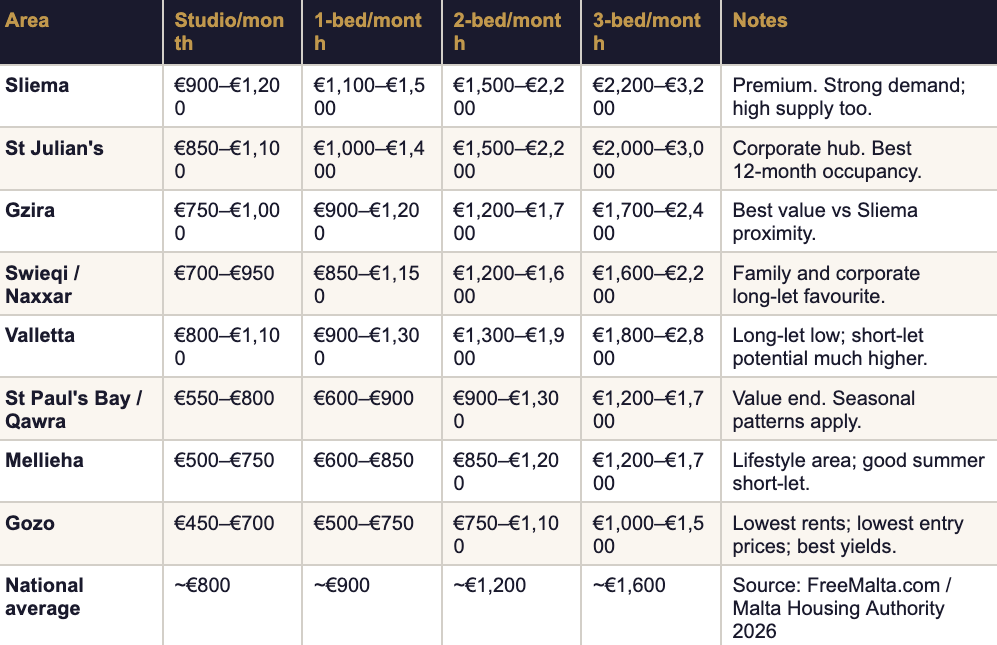
Rent growth has slowed sharply from the double-digit increases of 2021–2024. As of mid-2025, rent growth was running at approximately 2%–3% annually — significantly below the pace of property price appreciation. This compression is what is driving the gradual easing in gross yields nationally.
What Good Rental Yield Performance Looks Like in Malta
The investors who achieve the strongest rental yields in Malta consistently do the same things. Having placed over a thousand transactions, we know what the top performers do differently from those who are disappointed.
They buy in areas where tenant demand is structural, not just seasonal
St Julian's and Gzira have year-round corporate and iGaming tenant demand that does not disappear in October. Qawra has peak demand from tourists but requires active management to keep occupancy through winter. The best yields come from areas where demand does not need to be manufactured — it is already there, every month.
They buy apartments, not houses
Houses in Malta have underperformed on yield by a significant margin in 2025. A 2-bedroom apartment in Central Malta yielding 4% outperforms a 3-bedroom house in North Malta yielding 1.8% by more than double — and with shorter void periods and lower maintenance costs. The lifestyle appeal of a villa is real, but it comes at a direct cost to rental performance.
They match the property to the tenant profile
A furnished 1-bedroom apartment near the iGaming cluster in Swieqi does not need to be on Airbnb. It fills in four to seven days with a corporate tenant on a 12-month lease. A Gozo studio near the ferry terminal fills for summer with tourists. Knowing which tenant you are targeting — and choosing the property accordingly — is what separates 4% yields from 2% yields in the same postcode.
They use a management company from day one
For non-resident investors especially: self-managing a Malta rental property from abroad means slower let-up periods, delayed maintenance responses, and higher long-term void rates. A good Malta property management company charges 8%–12% of gross rent. On a €1,800/month apartment, that is €144–€216/month — the cost of a professional who fills the property faster, retains tenants longer, and handles every issue without requiring your involvement. It pays for itself.
Want to know which Malta property will yield what, and in which structure? The Alliance by Let Buy Mark team will give you the real numbers. Book your free consultation at letbuymark.com
Rental Yield Malta 2025: Quick Reference
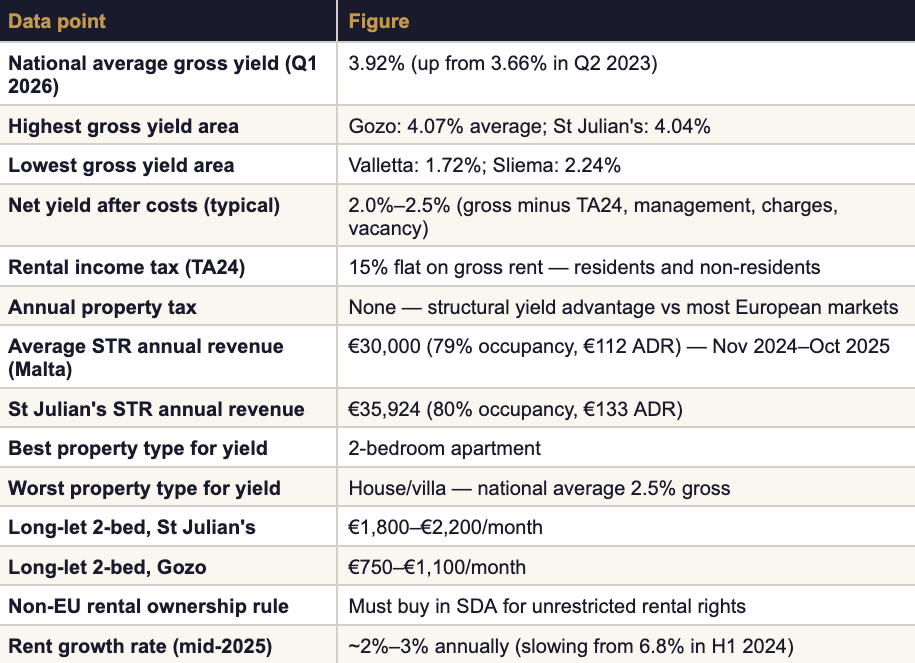
Malta rental yield is real, competitive within its European peer group, and — crucially — structurally supported by zero annual property tax and consistent capital appreciation. The investors who do best here are the ones who go in with accurate expectations, the right area, and the right structure.
[INTERNAL LINK: Invest in Malta property: the complete investor guide]
[INTERNAL LINK: Malta property investment return: what the numbers really show]
[INTERNAL LINK: Malta permanent residency scheme: property investment and EU access]
